
AQHI
Air Quality Health Index
The Air Quality Health Index, or AQHI, is a scale from 1 to 10+.
It helps show the health risk from current air quality. Lower numbers mean lower risk. Higher numbers mean higher risk.
AQHI Index Scale
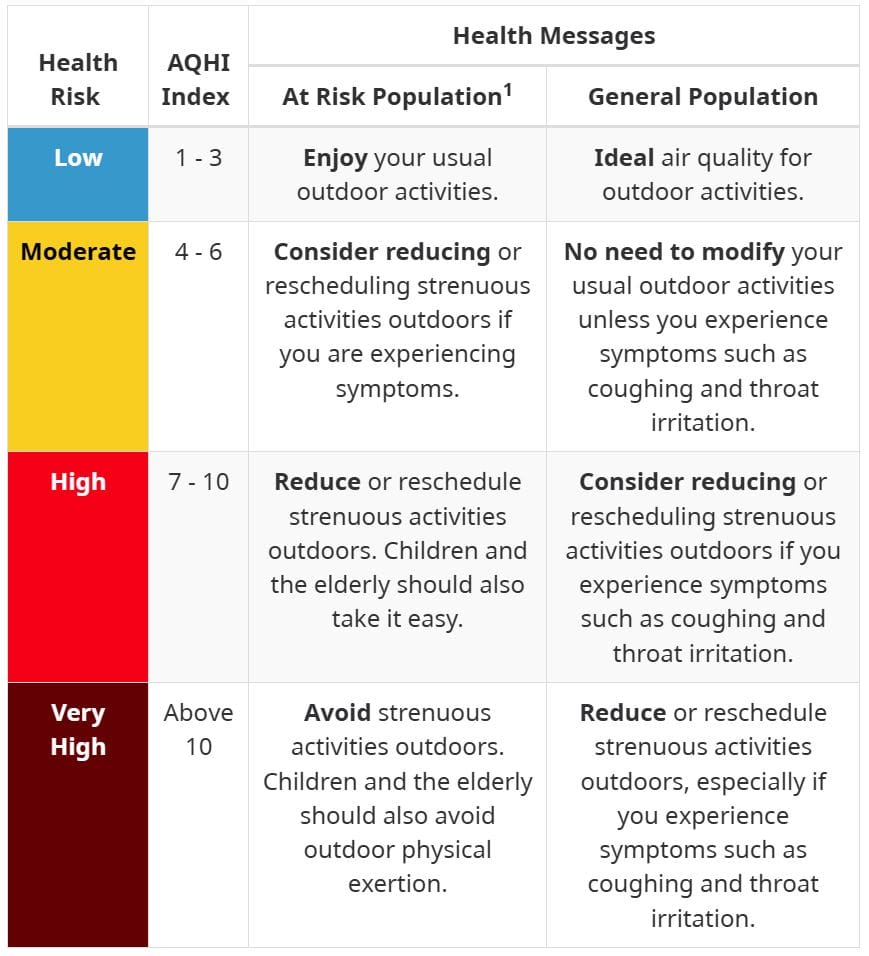
1 People with heart or breathing problems are at greater risk. Follow your doctor’s usual advice about exercising and managing your condition. [Source: Environment and Climate Change Canada]
* If the AQHI index has increased to 7 (high health risk), it is usually because of high concentrations of smoke particles (PM2.5) in this community.

About the Interactive Map Data
This map includes many different air quality measurements from monitoring stations across British Columbia.
In the Kitimat airshed, PM2.5, sulphur dioxide (SO₂), nitrogen dioxide (NO₂), and ozone (O₃) are among the key pollutants used to understand local air quality.
KAG is often asked whether benzene is measured. Benzene is not used to calculate the AQHI. Some related hydrocarbon monitoring is available through provincial air quality data and other monitoring programs.
Learn more about PM2.5, SO₂, NO₂, O₃, benzene, and other air pollutants.


AQHI FAQ
What is the AQHI?
The Air Quality Health Index, or AQHI, is a number that tells you how air quality may affect your health. It helps you decide if it is a good day to be active outside or if you should take it easier.
How do I read the AQHI?
The AQHI uses numbers from 1 to 10+.
1 to 3 means low risk.
4 to 6 means moderate risk.
7 to 10 means high risk.
10+ means very high risk.
The higher the number, the more careful you should be.
Why does the AQHI matter?
Air pollution can affect your lungs, heart, and breathing. The AQHI helps you make quick choices, like whether to go for a run, let kids play outside, or move hard outdoor work to another time.
Does air pollution affect everyone the same way?
No. Some people may be more affected by air pollution, including children, older adults, people who are active outdoors, and people with heart or breathing conditions. The AQHI gives general health guidance based on current air quality.
What should I do on smoky days?
Check the AQHI before spending time outside. If the number is high, consider reducing hard outdoor activity, closing windows, using filtered indoor air if available, and taking breaks indoors.
Can air look clear but still be polluted?
Yes. Some pollution is hard to see. That is why checking the AQHI is useful, even when the sky does not look smoky.
Can the air smell bad but still have a low AQHI?
Sometimes, yes. Smell and health risk are not always the same thing. The AQHI gives a better picture of health risk from measured air pollution.
Can AQHI data be delayed?
Yes. Data can sometimes be missing or delayed because of power outages, equipment maintenance, calibration, or communication problems.
Where can I check the AQHI?
You can check current and forecast AQHI values through the B.C. Air Quality webpage, the AQHI widget on this website, and local monitoring station links.
Get AQHI alerts on your phone
Download the WeatherCAN app to receive weather alerts and AQHI notifications on your mobile device.
You can add Kitimat, Haisla Village, or Terrace to follow local air quality conditions.